
Get Steady.
“The hero is a mind of such balance that no disturbances can shake his will.” – Emerson
Kyle Guy, a shooting guard for University of Virginia’s basketball team, was setting up at the free throw line. His Cavaliers were down by 2 points to Auburn, with a trip to the National Championship on the line.
Moments before, teammate Ty Jerome inbounded the ball to Kyle in the left corner for a potential game-winning three. As he rose to shoot, an energized Auburn defender made contact. Whistle. Foul. There were 0.6 seconds remaining on the clock.
One year before, Virginia basketball made headlines for being the first number 1 seed in the NCAA tournament to be knocked out by a 16 seed. The program was embarrassed. Kyle admits to struggling with anxiety during his time at Virginia. The pressure of his team’s underachievement, and the heavy public scrutiny, made it worse.
He and his teammates worked hard all offseason, put together an impressive regular season, and were chugging along through post-season play. As he walked to the free-throw line, he was carrying more than just the weight of the moment. His team was down 60-62. If he were to make 1 of 3 attempts, his team would lose. If he were to make 2 of 3, they would go to overtime. And if he could make all three shots, Virginia would be heading to the National Championship.
What would you do? Have you ever felt that sort of pressure? My experience suggests that countless among us falter under a fraction of the weight. Payroll needs to be submitted in an hour… The person I’m trying to work with hasn’t responded yet… there’s mayonnaise on this sandwich?!? The average person can handle any of those situations. But nerves take over. Intrusive thoughts, shaky knees, and self-doubt influence performance and perspective. It takes a lot less than a shot at a National Championship to make the average person unsteady.

Be Where Your Feet Are
Kyle took a breath. Of course he had the talent to make a free throw. He had made that shot thousands of times before. The question was not his talent, but ability to demonstrate that skill in the moment. For his mind to wander anywhere else (the 70,000 fans in the arena, the millions more watching from home, the previous year’s upset, any concern about what people might think of him if he missed, the chance to fulfill a lifelong dream and play for a National Championship…) would be wasteful. He used a mantra he had been practicing: be where your feet are. So simple. So powerful. His job in that moment was to be there, only there, right where his feet were, and do let his talent present.
Kyle didn’t have “ice in his veins”. He wasn’t some stone-cold superhero. He was a college kid, anxious, who has openly shared his struggles with mental health. But he was talented. And he had done the work to steady himself. He trained his eyes on the basket. He took a breath. Took one dribble, felt the ball in his hands, and took a shot.
It went in. Then again with the same routine: breath, dribble, shot. Kyle Guy sank three consecutive free throws to send his team to the National Championship. The next week they took down Texas Tech in overtime and the Cavaliers were National Champs.
Getting steady
is not about feeling “good”
or eliminating potentially negative stressors –
it is about getting to a place
where emotions are sensible in context,
and one feels prepared
to meet the challenge at hand.
Steadiness can include the conversation of emotion regulation. Note that emotion regulation is distinct from emotional denial. Steadiness is not about pretending that challenges are not upon us, or that we do not have the feelings that accompany those challenges.
When a romantic relationship comes to an end, for example, sadness might be a sensible emotion. It would be silly to pretend that the emotion does not exist. Depending on the context, sensible emotions can include disappointment, anger, or regret. These emotions can be uncomfortable, but they exist.
When you are tasked with a significant challenge, you might feel fear and uncertainty. Do not shut these things out. Emotions are real. (Yes, even for the tough guys out there.) Steadiness includes the ability to contextualize emotions and respond to situations appropriately, with intention.
An adult might leave a long day of work, sit in traffic, walk in the door and shout at their dog for no good reason… that’s a moment of unsteadiness. Steadiness and unsteadiness are not traits (something you are) but states (how you are in a moment). It’s worth examining moments of unsteadiness and getting curious about why they arrive. Being in tune with the inputs emotions is the first step in navigating them to achieve a steady state. Over time, an unwillingness to examine oneself can create deep-seeded mindset that produce behaviors that step on their own toes.
David vs. Goliath (also David)
“David” was a two-time All-State basketball player in high school. He was awarded a college scholarship and says he found support and personal validation through sport. By his sophomore year of college his studies had taken a distant backseat. Unable to dig himself out of that hole, he dropped out and began a career as an entrepreneur. He bounced around industries but eventually settled into real estate, where he has spent the bulk of his professional life.
Not long ago, David attempted a marketing campaign that didn’t work. He sent personalized letters out to potential buyers and, in his mind, really put himself out there. He felt vulnerable.
The marketing campaign didn’t work as well, or as quickly, as he hoped. He never tried again. His self-concept was defined by ‘winning’. He was dependent on external validation and the lack of it was unsettling to his core. When his peers, friends, and family asked about work, or what his next steps might be, he shut them out or shut them down – his defensive side would rear up. This defensiveness eliminated any potential for growth. Personal and professional relationships suffered.
Stories like this are far too common. How often do you see people get overly defensive when things don’t go their way? I know I have. And I used to be that way.They have a tendency to point fingers. They dodge questions. They try to prove that their strategy was right, and it was someone else’s fault that the outcome didn’t go the way they wanted.
Not winning a game
does not mean you are a loser.
Getting an ‘F’
does not mean you are a failure.
It means you lost in that moment –
Yes, that’s real.
But nothing is wrong with you.
Remembering that is not just a nicety, it is a performance necessity. Being overly defensive is the surest way to gloss over the truth of any issue and, in doing so, miss details and limit opportunities for growth.
David’s friends and family could not have cared less about the marketing campaign. They were curious and wanted to support. They knew that his sales numbers were not connected to who he was as a person, but he just could not get there. David’s biggest challenge was himself – he was the inglorious underdog, relying on the outside world to continually pat him on the back, missing the fact that his sense of personal value was his biggest opponent.
David carried a lot of shame. For a long time, the external validation he received from the basketball court was able to mask it. When that dried up, he found it difficult to recreate that validation. By connecting his behaviors and need for external validation to his concept of personal value, every misstep chipped away at the foundation of who he was. It did not have to be that way.
He was one of my first clients. I refer to him often and chose the pseudonym “David” for a reason. The story of David and Goliath depicts the triumph of an unlikely hero, a young shepherd named David, who defeats the giant warrior Goliath with only a sling and a stone, symbolizing the power of faith and courage over brute strength. This biblical narrative serves as a metaphor for overcoming seemingly insurmountable challenges, emphasizing that true strength often lies in resourcefulness and conviction rather than size or status.
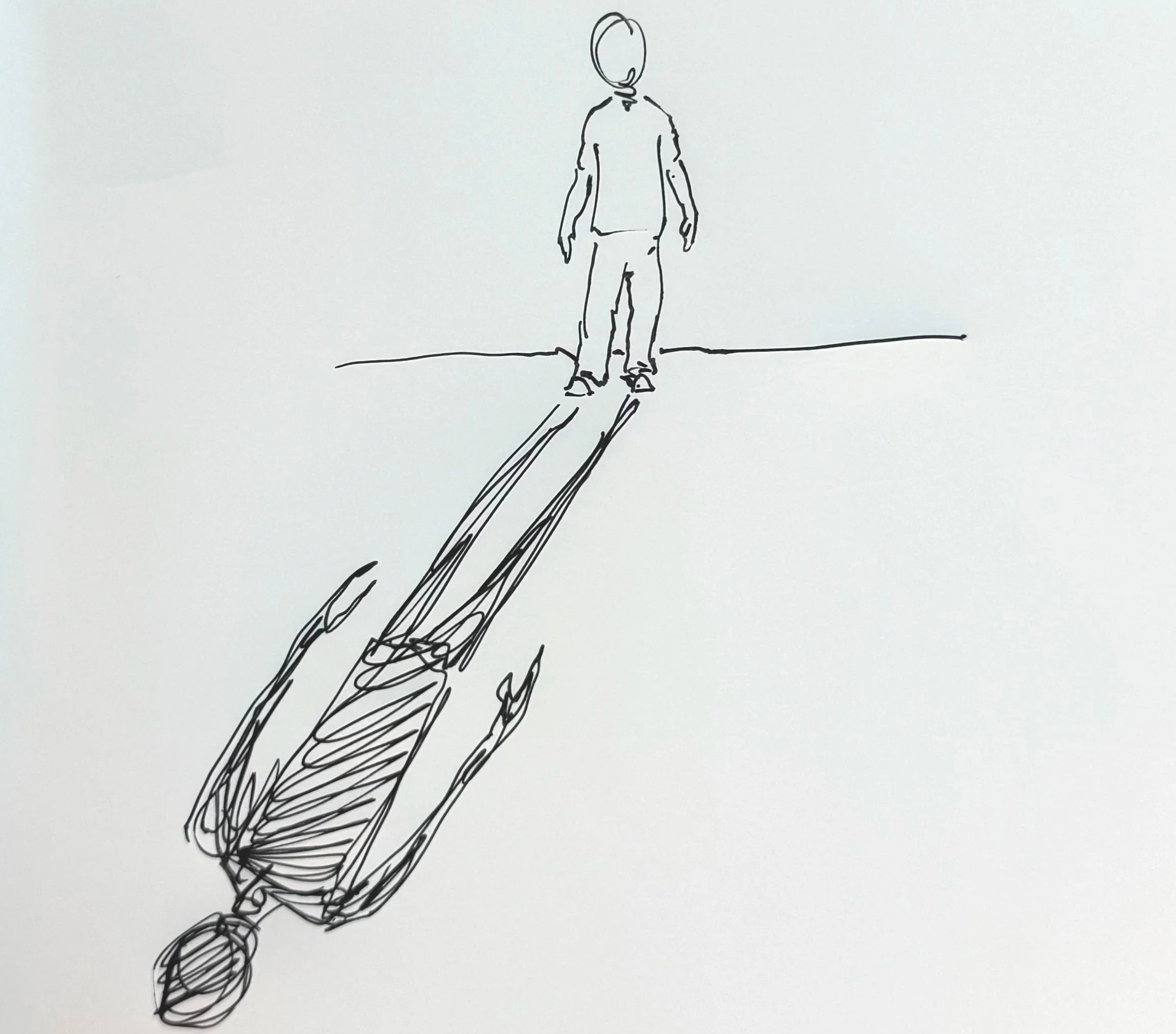
In so many cases, our biggest challenge, our “Goliath”, is ourselves. We battle a giant who turns out to be an intimidating reflection of our own fear, hesitation, and self-doubt. In the story, it takes the nimble, creative, self-assured David to take down the imposing, rigid, lumbering Goliath.
The challenge to advancement often looks like this:
Inability to accept accountability and thoughtfully review after setback
which presents as
Defensiveness, finger-pointing, shifting of blame, or avoidance
which are skills and strategies influenced by
Discomfort with the acknowledgement of one’s personal role in the setback
which stems from a mindset like
This setback means that I failed, that I am a failure.
Does this sound familiar? When this is the case, one assumes that outcomes define their personal value. With that false idea imprinted in their mindset, they develop skills and strategies to defend against insults to that value. Time and time again, when we walk back performance issues to their root cause, we find this type of unsteadiness.
The task for so many high achievers, especially in the moments which matter most, is to get steady. You matter. Whether or not you make the next free throw, or the next big sale, does not shake that. Worrying about what people will think if you miss the shot will not make you better at free throws. Quite the opposite.
Stability requires a separation
of performance and personal value.
A competition might matter to you,
but it’s not you.
Get steady. Get stable. Then build.
